Curabrein Get the app NL

Some days you can. Some days you can’t.
Both of them count.

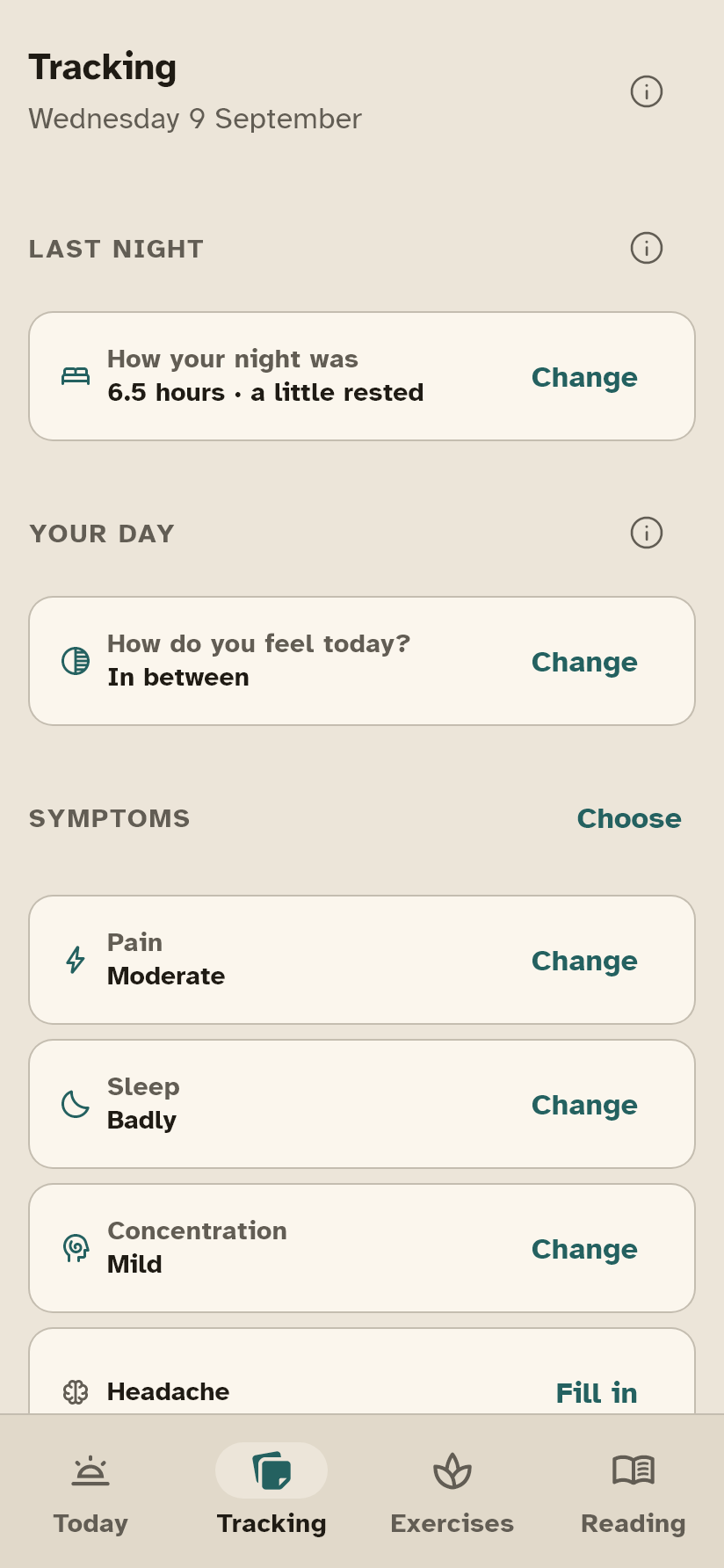
An app for people living with ME/CFS, long COVID, POTS, fibromyalgia, migraine and other illnesses that never show on the outside. It keeps your days for you, so that when you finally get an appointment you have more to say than “it’s been bad.”

Get it on Google Play Coming to Google Play €9.99 once, and that is all of it

Android. An iPhone version may follow.

No internet permissionNot a promise. The app cannot send anything.
No accountNothing to sign up for, nothing to remember.
No advertisingNot one banner, ever.
One paymentNo subscription arriving every month.
Breathe together
Longer out-breath 4-6

Follow him with your breath. Nothing is counted and there is no end: you stop whenever you want.

Stopping is fine
From the person who made it

I have functional non-epileptic seizures and PTSD. It took years before anyone could tell me what I actually had. That is not really the point though. The point is that those years taught me how this feels from the inside.

The idea for Curabrein came from my psychologist. I was building a game at the time, and she asked whether I could make apps as well. I said I would like to try. I kept trying and kept building, and this is where it ended up. We still go through it together and work out what could be better.

I know an app is not a cure, and I would never pretend otherwise. But if it can give somebody a little help in a hard stretch, that is genuinely enough for me. That is the whole goal.

YentheBelgium

More about why I built this →

Why this exists

When nothing shows on a scan, two things happen.

You lose your own weeks. Brain fog takes the details, one bad month blurs into the next, and by the time you are sitting in front of a doctor you can only say that it has been bad.

And you are not believed. Not out of malice. There is simply nothing to point at.

Curabrein solves the first problem so that it can help with the second. A few taps a day is all it asks. What it gives back is a record: months of your life, laid out on paper, in the shape a doctor already knows how to read.

Seeing the pattern

The crash comes days later. That is why you never catch it.

Post-exertional malaise usually arrives twelve to forty-eight hours after the effort that caused it. By then you have done six other things and the link is gone.

This screen puts your days next to each other. Every column is one day, oldest on the left. Each row is one thing you follow, and the darker a cell is, the more there was of it that day. So a run of dark cells in the crash row, with dark cells in "over your budget" a day or two to the left of it, is the pattern you could never hold in your head.

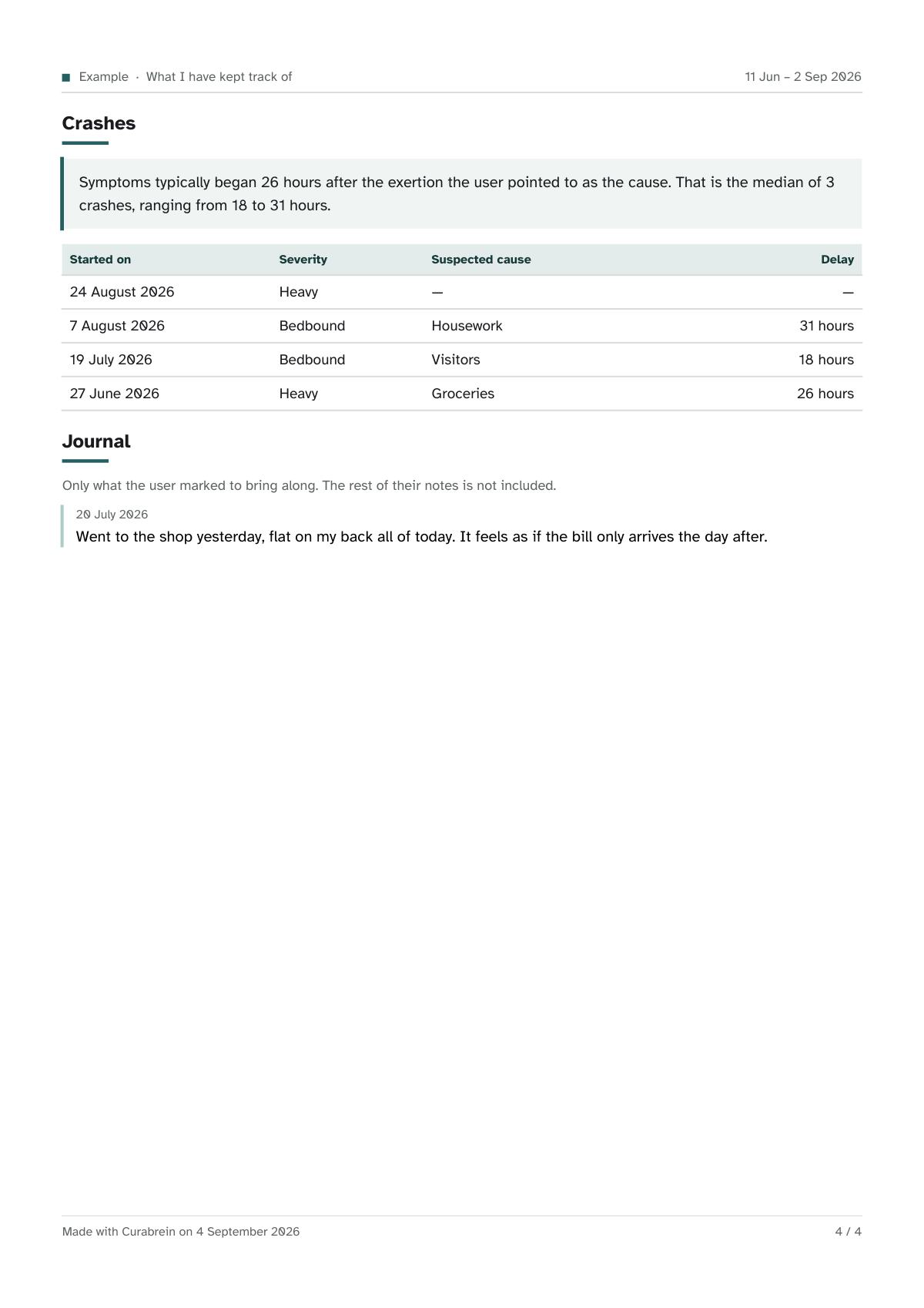
Once you have noted enough crashes, the app works out the delay that is typical for you and the range it varies within. Not a general number from a study. Yours.

  • Tap any day to see exactly what was there
  • Four weeks, three months or a year at a time
  • Only the things you chose to follow appear
The Looking back screen: rows for crash, over your budget, energy, pain, sleep and concentration, each a strip of small coloured cells, one per day.
For the appointment

A document you can hand over.

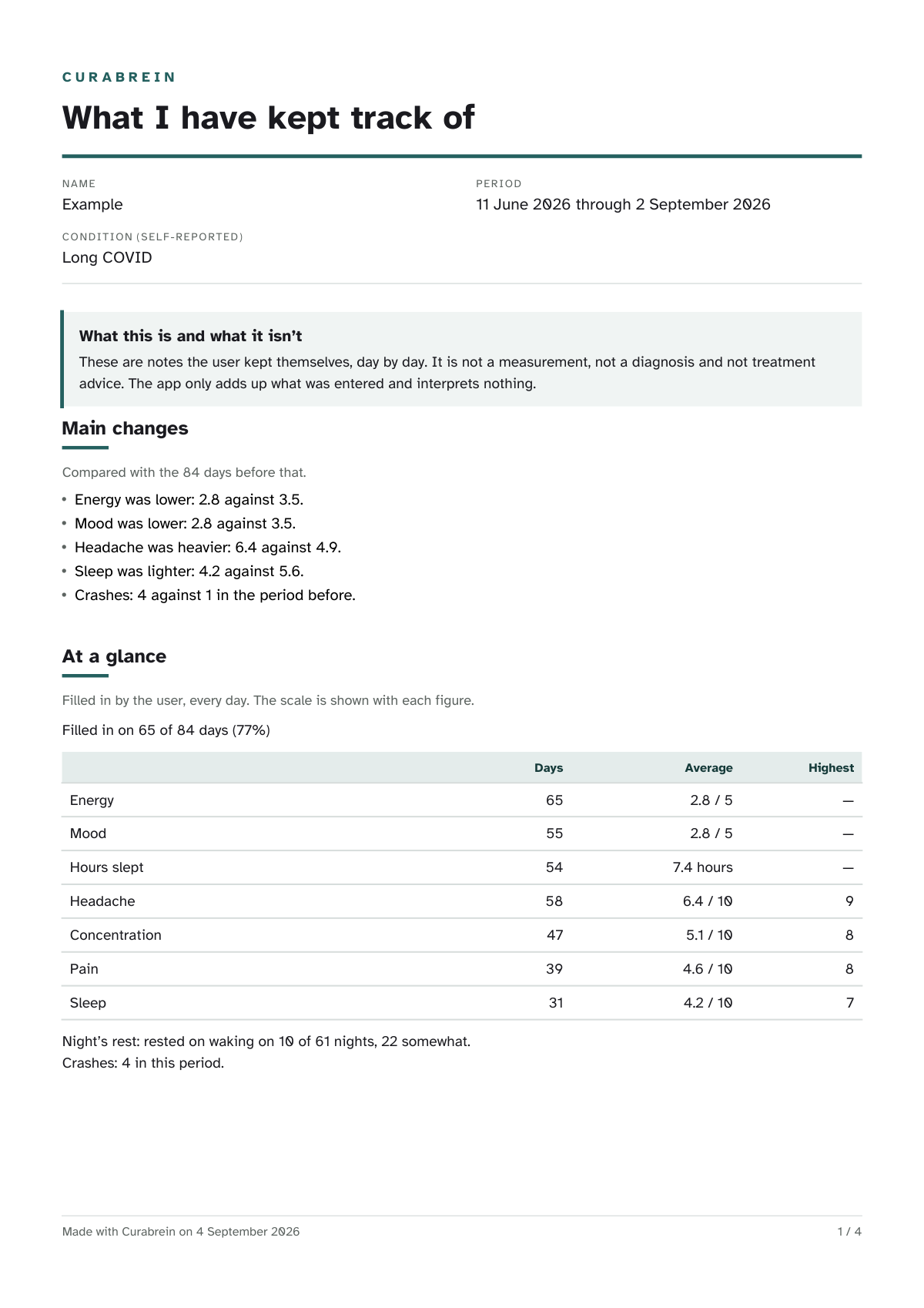
Print it, mail it, or just hand over your phone. Your name and the period on every page. Days filled in, average energy, how many crashes, how much you rested, and what changed since last time.

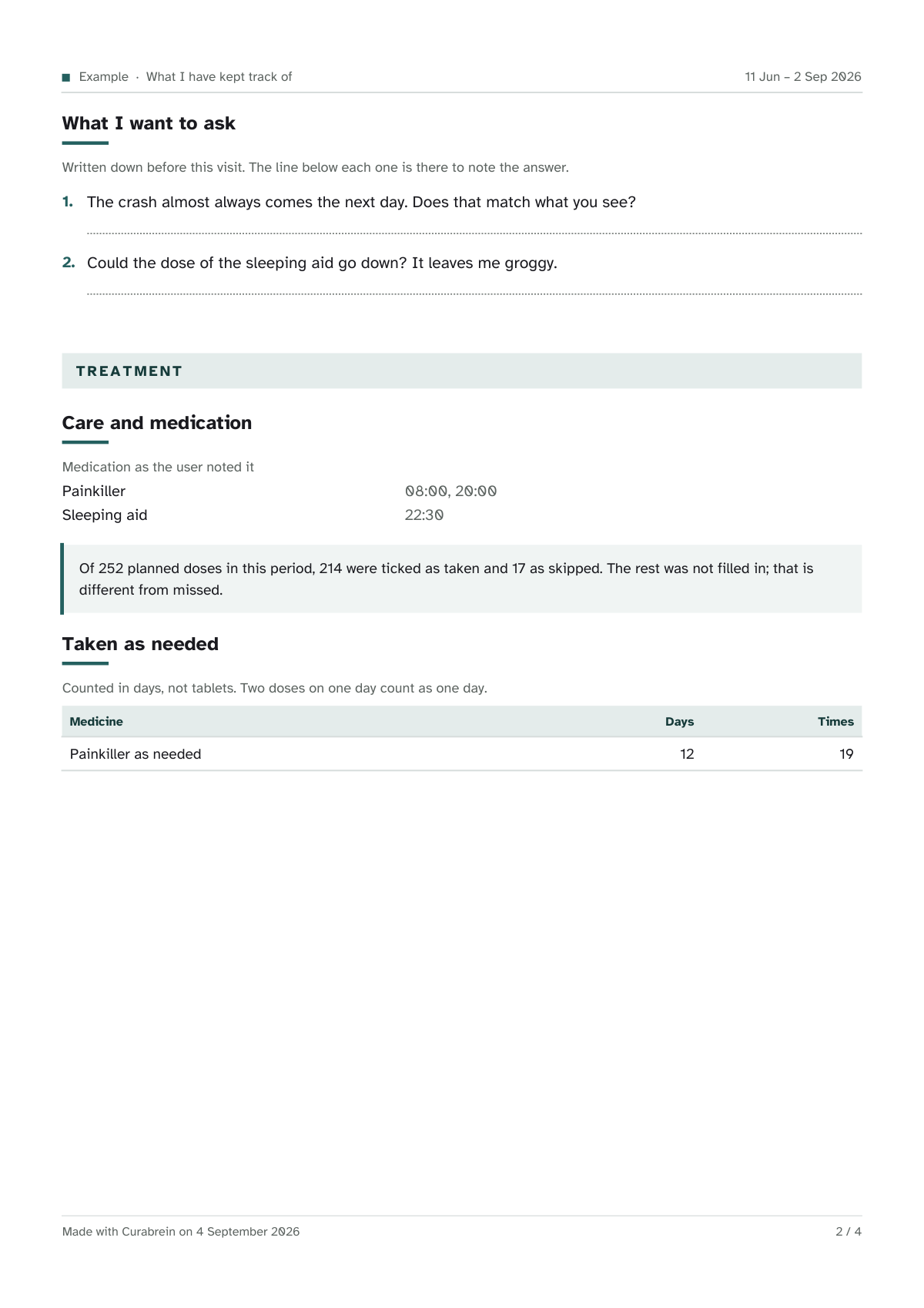
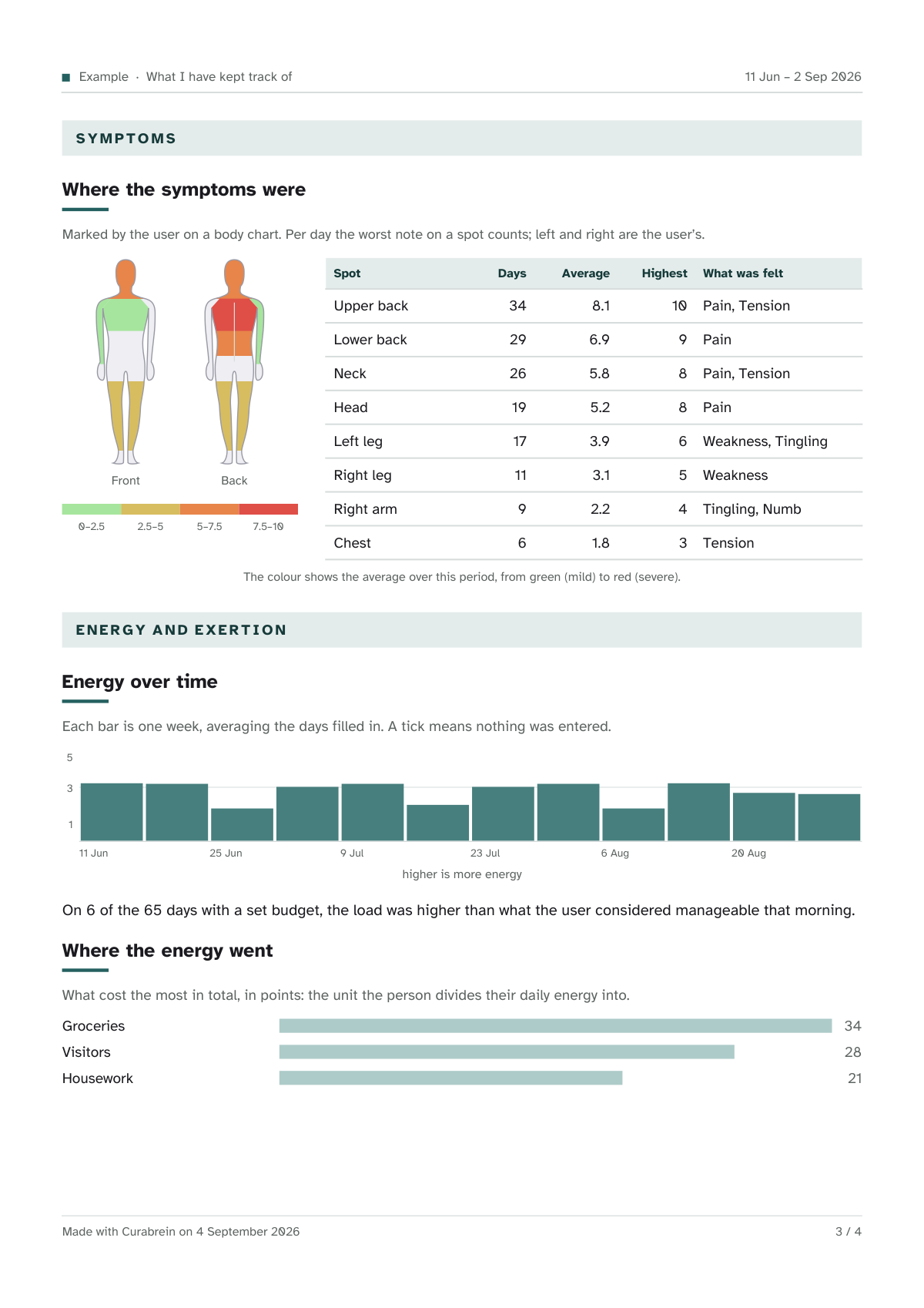
Then energy per day, load against your own budget, where the energy went, the body map as a coloured figure, sleep and mood, medication and what happened after a dose changed. And the questions you wrote down in the weeks before, each with a line under it to note the answer, so you do not leave the room having forgotten the thing you went in for.

It says plainly, at the top, that these are notes a person kept and not a measurement. That sentence is there so nobody has to argue about it.

It comes out in your language. The app and this document are in Dutch, English and French today, with German and Spanish being finished. So you hand your doctor something written in the language you both actually speak.

Everything on the document →

Page one: name, date of birth, period and condition, four figures, and a table comparing this period with the one before.
Page two: the questions to ask, then medication and a before and after comparison around a dose change.
Page three of the document for your doctor.
Page four: a bar chart of energy for each day, a chart of load against budget, and where the energy went.

Page 1 of 4 · the worked example that is built into the app

On the bad days

Twenty exercises. None of them asks you to push through.

The list is filtered by the conditions you chose. If you have ME/CFS, nothing that asks for real exertion can appear. That rule is checked automatically every single time the app is built, because it is far too important to leave to somebody remembering.

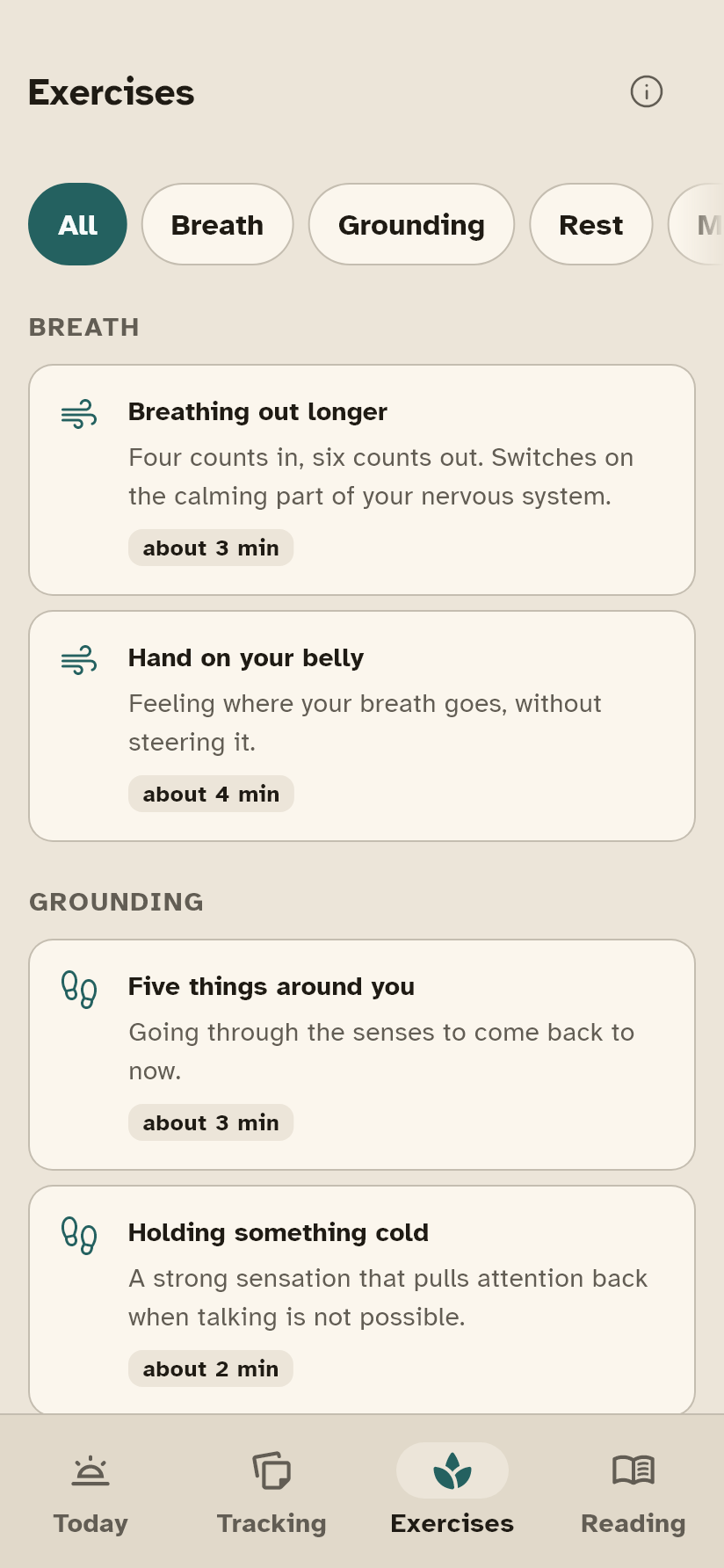
A body scan that walks your attention through you, one part at a time, with your companion sitting alongside. Grounding for when the room is too much. Breathing with a rhythm you pick yourself. Shoulder and leg movements at a pace a moving dot shows you. And a few that ask you to put the phone down first, which say so before you start.

  • Nothing is counted and nothing is scored
  • Pause and skip are on the screen, and stopping halfway is offered rather than punished
  • Your companion breathes along, or stays out of it entirely

These keep getting better. New exercises are being added, and the ones that are here are reworked whenever somebody tells me what does not sit right. Physiotherapy movements with real pictures are next.

The body scan exercise: Going through your body, currently resting on your feet, with a progress bar, pause and skip, and the companion sitting below.
84conditions in the library, each written to be read on a bad day
20exercises, filtered so that only what is safe for you appears
5languages, with Dutch, English and French complete
0trackers, analytics and adverts, in the app and on this page
Still growing

The app you buy today is not the app you get next year.

Eighty-four conditions is where it starts, not where it stops. More are being written, and every one of them takes as long as it takes, because a page that is wrong is worse than a page that does not exist yet.

More exercises are coming too, including physiotherapy movements with real pictures rather than descriptions. If something you need is missing, tell me and it moves up the list. That is genuinely how the order gets decided.

All of it arrives as a normal update. You paid once, so you keep getting it.

Tell me what is missing →

Your data

Your record never leaves your phone.

Not as a promise. As a permission we did not ask for.

Curabrein has no internet permission at all, and Android says so on the store page. The app is not able to send your record anywhere, which means you do not have to take anyone's word for it.

Everything you write is encrypted on your own device, with a key kept in the Android Keystore. There are no servers, so there is nothing for anyone to break into and nothing for me to hand over.

This website holds itself to the same rule. No fonts from Google, no scripts from anyone else, no analytics, and no cookie banner, because there is nothing to consent to.

Read the full privacy statement →

One payment €9.99

once, and the app is yours

Comparable apps: €4 to €10 every month

What you are getting

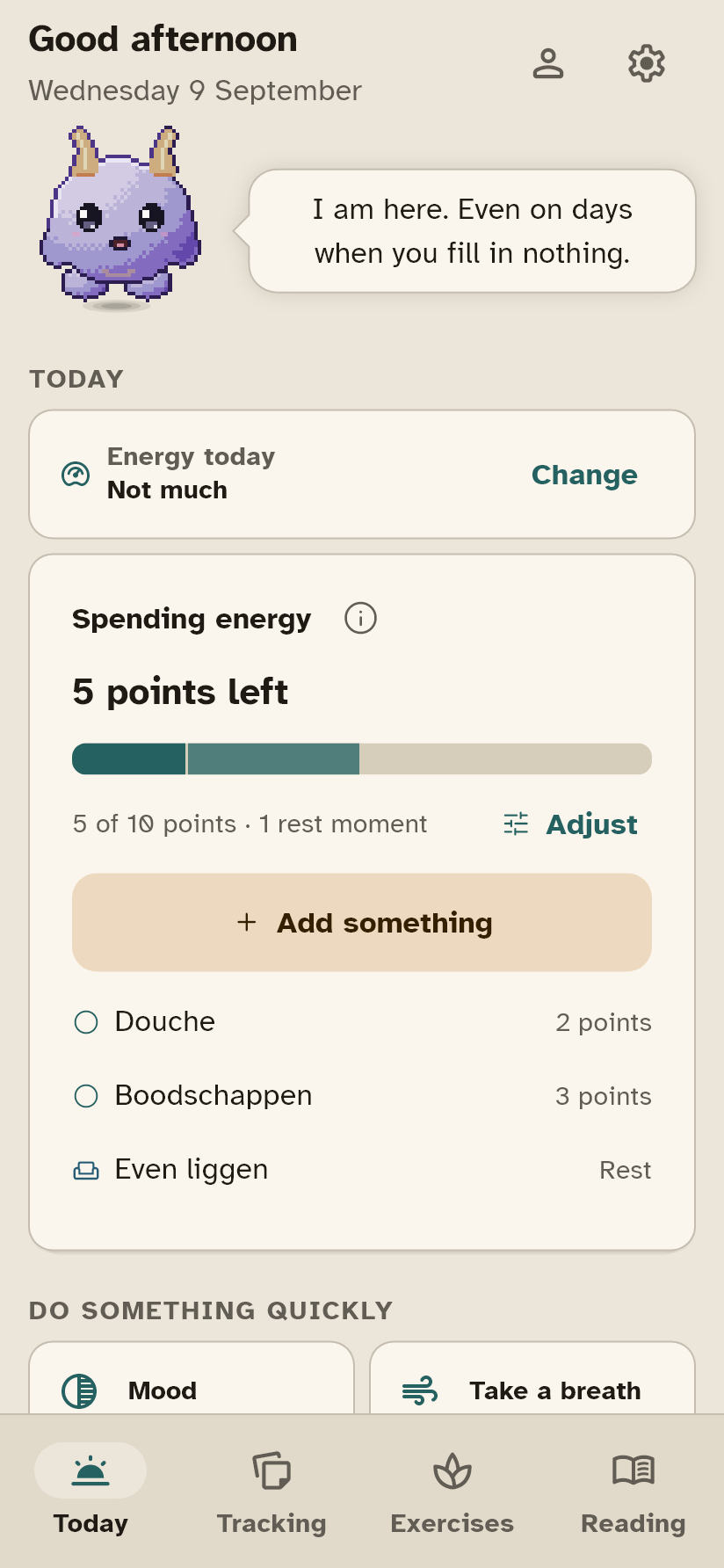
  • Your energy, and what it cost you. Five levels and one tap on a bad day. Spoons and a budget if you count that way.
  • Crashes, with your own delay. Not twelve to forty-eight hours from a study. The number your own weeks work out to.
  • Months of your days on one grid. The thing you can hand to somebody and say: look, this is what it has been like.
  • Twenty exercises that never push you. Filtered by your conditions, so nothing unsafe for you can turn up.
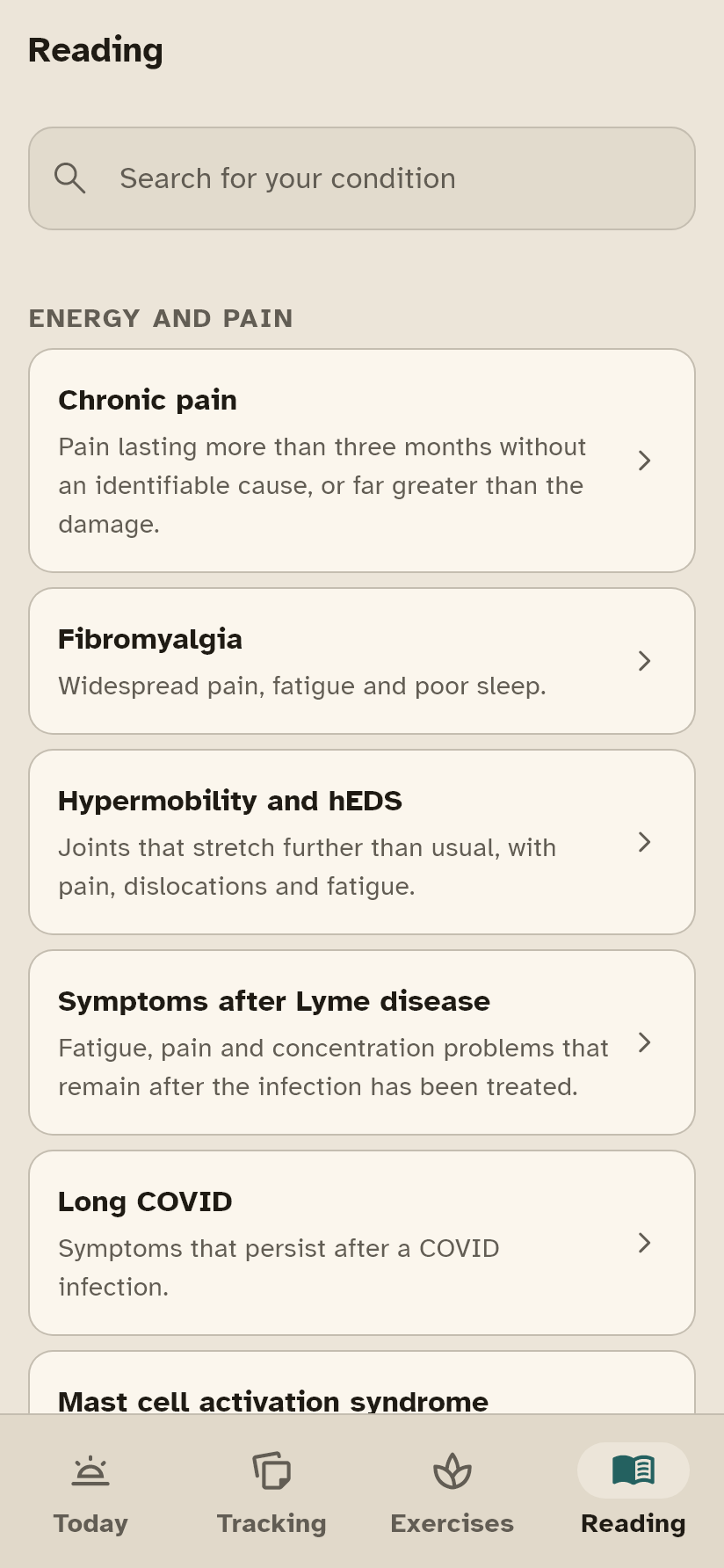
  • Eighty-four conditions, written for a bad day. Short paragraphs, plain words, and it will read them aloud if that is easier.
  • The document for your doctor. Print it, mail it, or hand over your phone.

The body map, symptoms, sleep, mood, cycle, medication and reminders, four companions and four themes are all in there too. Nothing is locked and nothing is a higher tier. Everything, in detail →

Curabrein does not diagnose and does not treat. It keeps your record and it gives you information. What that record means is a conversation between you and your doctor. If you are in crisis, the app has a page with the emergency numbers for your country, and in Europe you can always call 112.