 Curabrein
When a patient hands you this document.
What Curabrein is, where the numbers come from, and what you can and cannot read into it.
A record, not a measurement.
An app for people with a chronic condition, to keep daily track of how things are going and to bring that to an appointment with you. The app measures nothing, makes no diagnosis and gives no treatment advice. It adds up what a person filled in, and does not interpret it.
What you receive is the patient’s own record: in numbers, and in their own words.
The app infers nothing from sensors or other apps. Everything was filled in by the patient.
Every day, filled in by hand.
Per day: energy and mood on a scale of five, the night, symptoms on a scale of ten, and where in the body it sat. What a day costs in a unit of their own, and what the patient allowed themselves that morning.
Alongside that: crashes, with the time between exertion and symptoms. Days they knew in advance would be heavy. Medication and dose changes. And in their own words: a diary, and the questions they want to ask you.
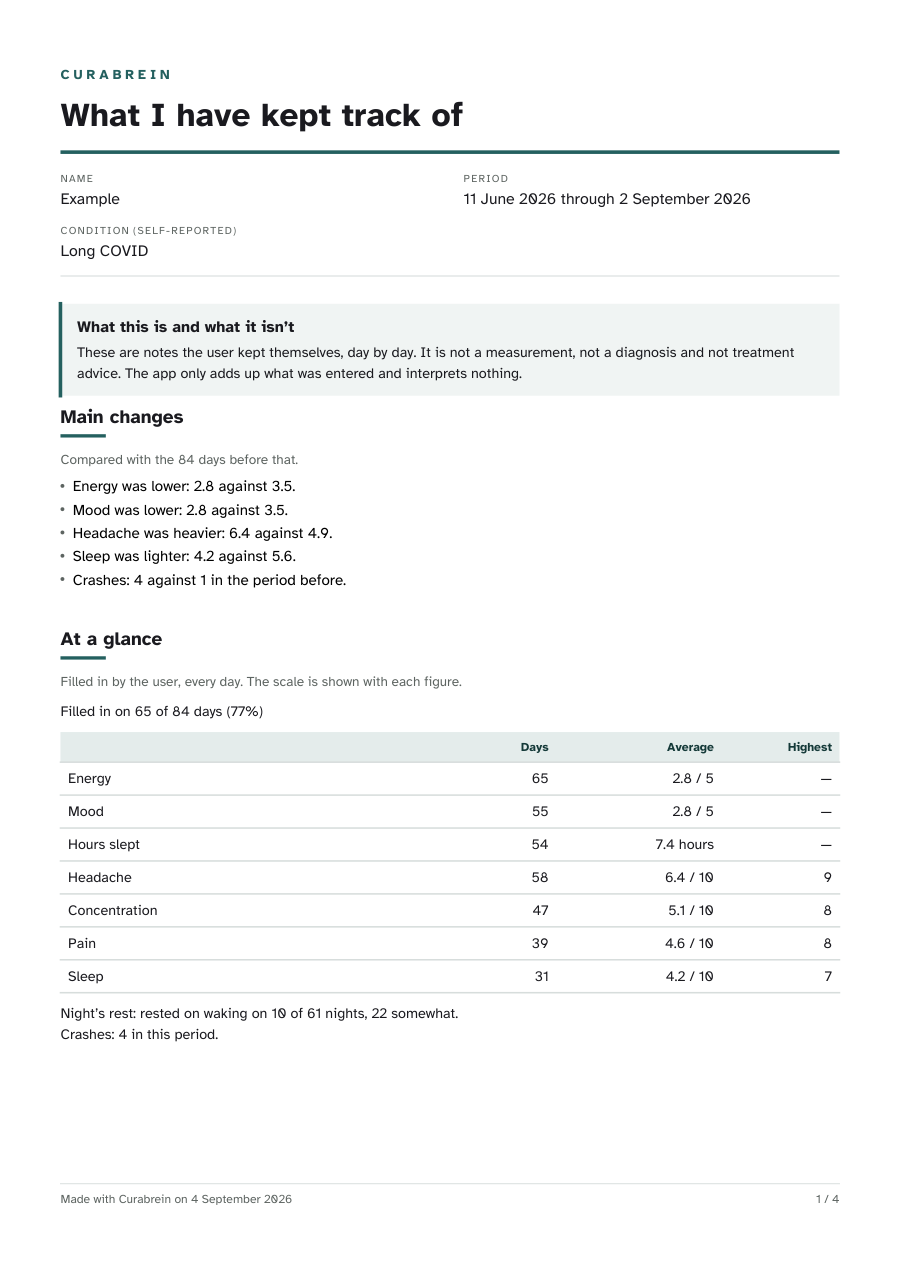
Page one is made to be read in two minutes.
The patient chooses a period and the app summarises it on a few pages. What sits at the top sits there for a reason.
- How completely it was keptAbove the numbers, not below them. “Filled in on 65 of 84 days” says how much weight everything that follows can carry.
- What changedAgainst the period before, and only when both periods are filled in well enough to compare fairly. Small differences are not mentioned: in numbers filled in daily, they are noise.
- The core numbersPer item, on how many days it was filled in, the average with its scale, and the highest value.
- Then the patient’s questionsWritten down before the appointment, with a line underneath to write your answer on. In a full record they start on page two.
Further on in the document:
- Where the symptoms sat, on a body map.
- The course of the energy, with dates, and what cost the most.
- The crashes, with the time between exertion and symptoms.
- After a dose change: the four weeks before next to the four weeks after.
That comparison does not say whether a medicine works. It is one person, without a control, with all sorts of things changing at once, and the document says so. And from the diary, only what the patient chose to include. The rest you do not see.
No questionnaire, no screening.
Mood is a scale of its own, not a validated instrument. A number is not a measurement. The app never tells the patient what something means; that conversation is yours, and it says so at the top of the first page of every document.
Only what is safe for that condition.
Twenty short exercises: breathing, grounding, rest, light movement, and dealing with thoughts. Per condition, only the exercises that fit are shown. Someone with post-exertional malaise is never offered exertion. The library describes 84 conditions, each with sources.
Curabrein sends nothing.
There is no account and no server. The app has no permission to use the internet; you can check that in the Play Store, under permissions. What the patient fills in is stored encrypted on their own device, and they decide what they hand to you.
A question about what is in the document, or about what the app does and does not do? Do ask.